Introduction
I have been fortunate to deliver CPD worldwide for over 15 years now. I know this is a cocky thing to say, but my reviews are always outstanding. Here are three examples.
I just wanted to pass on my heartfelt thanks for the two sessions you ran this Monday. I can honestly say that so many members of staff were captivated by your ideas and how they can be implemented into our classrooms. The greatest accolade I can give is many have requested to have you every year at our training day!
Finlay Ridgwell – Sigma Trust
Just wanted to thank you for taking the time to come to Aberdeen for yesterday’s CPD event. Of the 85 particpants there, there is not one who left the room without leaving positive feedback on the day. It is a very rare opportunity for staff to come together to get subject specific CPD and this was much appreciated as was the quality of the event delivery and your practical and actionable strategies. There are now a few actions for us as a group to take forward in order to make things happen in the classrooms.
Fiona Jamieson – Aberdeen City Council
On behalf of our schools, I want to express our gratitude and thanks for your time and expertise in delivering the maths keynote session as part of our Curriculum Advancement Day. The initial feedback is really positive and the discussions and ideas sparked by your session have already begun shaping some next steps; we are excited to see how your session will influence our work moving forward and secure brilliant checking for understanding in Lift classrooms!
Deborah McCarthy – LIFT schools
90-minute online workshops
For £99, a school or department can purchase one of my online workshops. Each workshop is designed to be watched with colleagues, with opportunities to discuss and plan together. View the range of workshops here, or view the books based on these workshops here.
Full-day face-to-face CPD
Here are the full-day workshops I run, along with the type of audience they are for. Each workshop is packed with evidence-based, practical ideas, so your audience can try them the next time they step into a classroom. I
f you wish an area covered outside of this, then I am not the speaker for you. I only speak on topics I have vast experience with, so your audience leaves with concrete strategies that have a high probability of success.
Workshop 1: The means of participation
Description: We can ask our students to participate in many ways in our classrooms. This workshop focuses on three: Cold Call, Turn and Talk, and Call and Respond. For each means of participation, we look at the evidence and the strategies that will help you and your students get the most out of them.
Relevance: Teachers of all subjects and phases
Workshop 2: Checking for listening
Description: If students are not listening, they will not understand. It’s as simple as that. Unfortunately, many students do not listen to our instructions, explanations, or their classmates. We examine why and what practical steps we can take to improve our students’ attention.
Relevance: Teachers of all subjects and phases
Workshop 3: Checking for understanding and responsive teaching
Description: Teaching without checking for understanding is like painting with your eyes closed. We need classrooms where students are willing to share their thinking, and strategies to collect the data. But checking for understanding is only half the battle. Once we have data on what our students know and don’t know, we have to respond appropriately. This workshop addresses both issues and shares concrete strategies to help teachers take formative assessment to the next level.
Relevance: Teachers of all subjects and phases
Workshop 4: Atomisation
Description: Atomisation is the single most positive change I’ve made to my teaching in the last 10 years. Atomisation is not just breaking a topic down; it’s a specific type of explicit instruction that makes all students feel smart and successful. In this workshop, we look at how to break routines into atoms, label atoms, and then teach and assess each type of atom in a way that is engaging, efficient, and astonishingly effective.
Relevance: Maths teachers from upper primary to secondary
Workshop 5: I Do, We Do, You Do
Description: Many teachers will be familiar with the terms “I Do,” “We Do,” and “You Do,” but the way they are delivered is what often makes the difference between a student understanding a process and being confused. In this workshop, we look at what makes a teacher-led “I Do” effective, how to gather data from all students during the “We Do,” and how to transition to independent practice efficiently and calmly.
Relevance: Maths teachers from upper primary to secondary
Workshop 6: Purposeful Practice and Problem-Solving
Description: Maths is so much more than just carrying out algorithms and procedures. If we want our students to become confident, successful, flexible mathematicians, we need to give them activities that go beyond consolidation. In this workshop, we’ll look at six such activity structures and the strategies that underpin them to help all our students become successful mathematicians.
Relevance: Maths teachers from upper primary to secondary
Workshop 7: Do Nows and Low-Stakes Quizzes
Description: Most teachers accept that retrieval practice is important to help students remember things, but finding time for such retrieval practice and delivering it in a way that’s effective can be the difference between students remembering what they once knew and not. In this workshop, we look at two potentially powerful retrieval opportunities: the start of the lesson, otherwise known as the do now, and a weekly low-stakes quiz.
Relevance: Maths teachers from upper primary to secondary
FAQs
Are these workshops just for secondary school maths teachers?
Please read the Relevance section accompanying each workshop description to determine how relevant each workshop is likely to be for your audience.
Are any of these workshops suitable for keynotes or shorter sessions?
Each workshop is designed to last a full day, giving delegates enough time to process, discuss, and practice each idea. If you would like me to deliver a keynote or shorter workshop in under 90 minutes, then please get in touch to discuss the feasibility.
What timings do you suggest for the face-to-face CPD events?
The day is cognitively demanding for delegates, so I recommend at least a 30-minute morning break, 45 minutes for lunch, and a 15-minute afternoon break. This will allow delegates to recharge and discuss ideas further.
Here is an example from a recent event that worked well:
- 8.45am to 9am: Arrival
- 9am to 10.30am: Session 1
- 10.30am to 11am: Break
- 11am to 12.30pm: Session 2
- 12.30pm to 1.15pm: Lunch
- 1.15pm to 2.15pm: Session 3
- 2.15pm to 2.45pm: Break
- 2.45pm to 3.15pm: Reflections, questions, forward-planning
This is just a guide, and I can adapt to fit around school lunches, breaks, etc.
Will you share your slides with the delegates?
Instead of sharing slides, I will provide delegates with a link to access the material covered during the CPD.
What are your requirements regarding technology/room set-up/dietary requirements?
I can work with most set-ups at in-person events, but the following things are essential:
- Access to a projector / interactive whiteboard.
- I don’t require any printing
- All delegates must be able to see the writing on the projector or whiteboard. Since I don’t work from handouts, I’ll project everything onto the board. This is extremely important, as poor visibility can spoil the experience.
- I use my own laptop (MacBook Air), and must be able to connect it to the projector/whiteboard via either HDMI, VGA or Apple TV – I have adapters for each. Please note: I have fonts and software installed on my laptop, so I can’t run my presentation through the venue’s laptop.
- Access to sound loud enough for everyone in the room to hear.
- Access to wifi via my laptop.
- If the room is large and requires a microphone, please provide a clip-on mic so I can move around with my hands free.
- Delegates have access to pens, pencils and paper
- Delegates arranged in a cabaret style in groups of 4 to 10 – i.e. not a lecture theatre-style
- A schedule for the day in advance that includes: start time, end time, lunch, and breaks.
The following things are desirable:
- A mini-whiteboard per person (with pen and duster!)
- Tables arranged in groups of between 4 and 8
- A ready supply of water… tap is fine 😉
- My only food-related fussiness is that I don’t like fish or mayonnaise!
If any of these are issues, please let me know in advance, and we will try to resolve them.
To enquire about booking Craig
To discuss a booking, please get in touch with my lovely agent, Katie:
katie@thelearningline.co.uk
Tel. 01522 708897
Biography and Photo
I often get asked to provide a biography and a photo to help promote the workshops I am involved in. Please find them below.
Bio
Craig Barton loves teaching, doing, speaking and thinking about mathematics. He taught maths in secondary schools for 15 years, and was TES Maths Adviser for 10 years. He is now the Chief Academic Officer at Eedi.
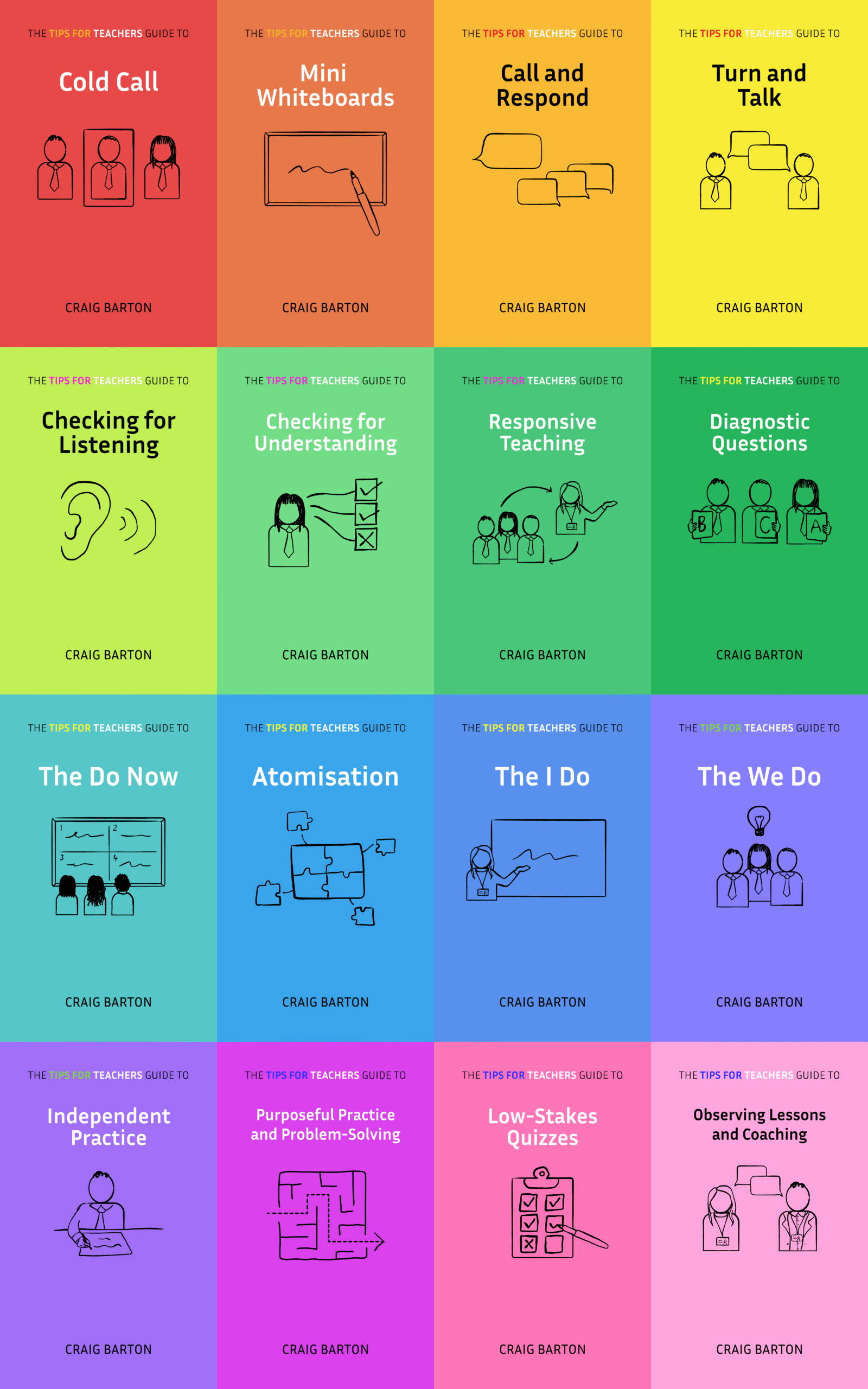
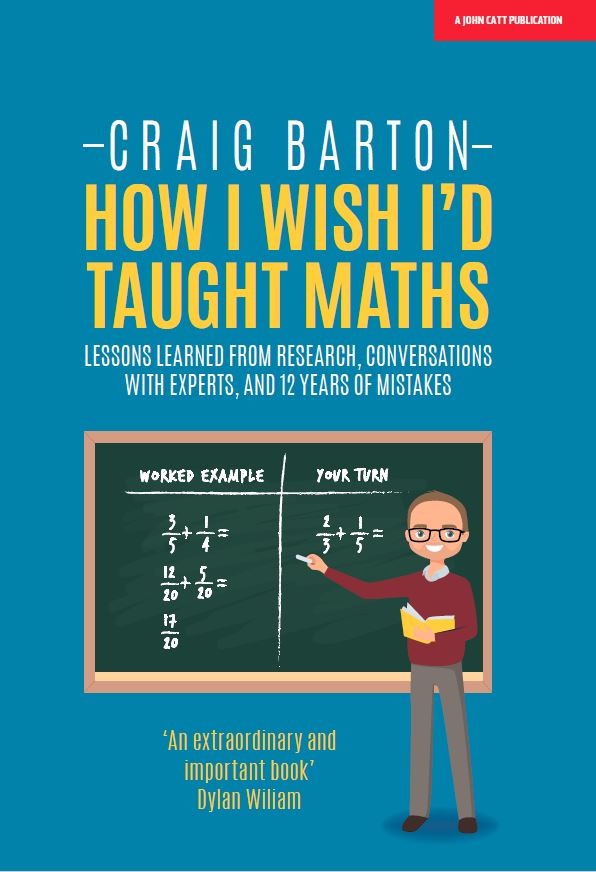
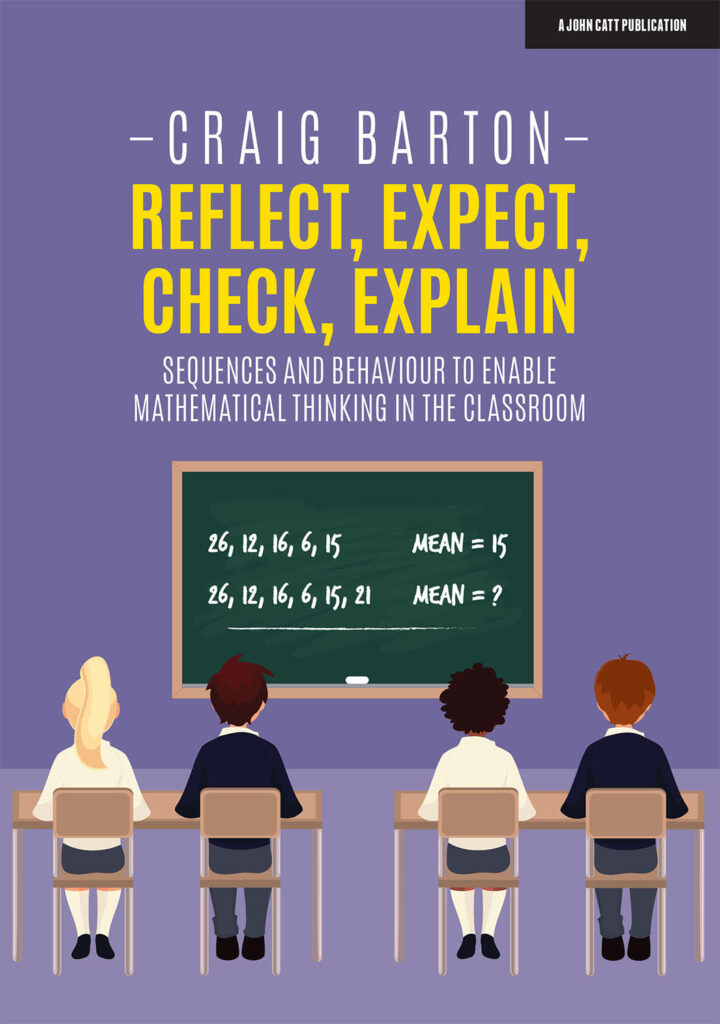
Craig is the author of many best-selling books, including “How I wish I’d taught maths”, “Reflect, Expect, Check, Explain” and the “Tips for Teachers guide to…” series. He hosts the Mr Barton Maths podcast and has created far too many websites.
In 2020, he was appointed as a Visiting Fellow at the Mathematics Education Centre at the University of Loughborough. Craig has been lucky enough to teach maths and work with teachers and students worldwide.
Photo
If you need a high-quality image, then you can download one here.