Here are the resources referenced in the Tips for Teachers guide to The I Do.
Want to know more?
The following books dive deep into the complexities of explanations and worked examples:
Footnotes
- Worked Examples Moderate the Effect of Math Learning Anxiety by Mesingha et al. Read an analysis of the paper here
- #082 Mark McCourt: the return! Teaching for mastery. You can listen to the conversation here
- You can read more about planning Learning Episodes here
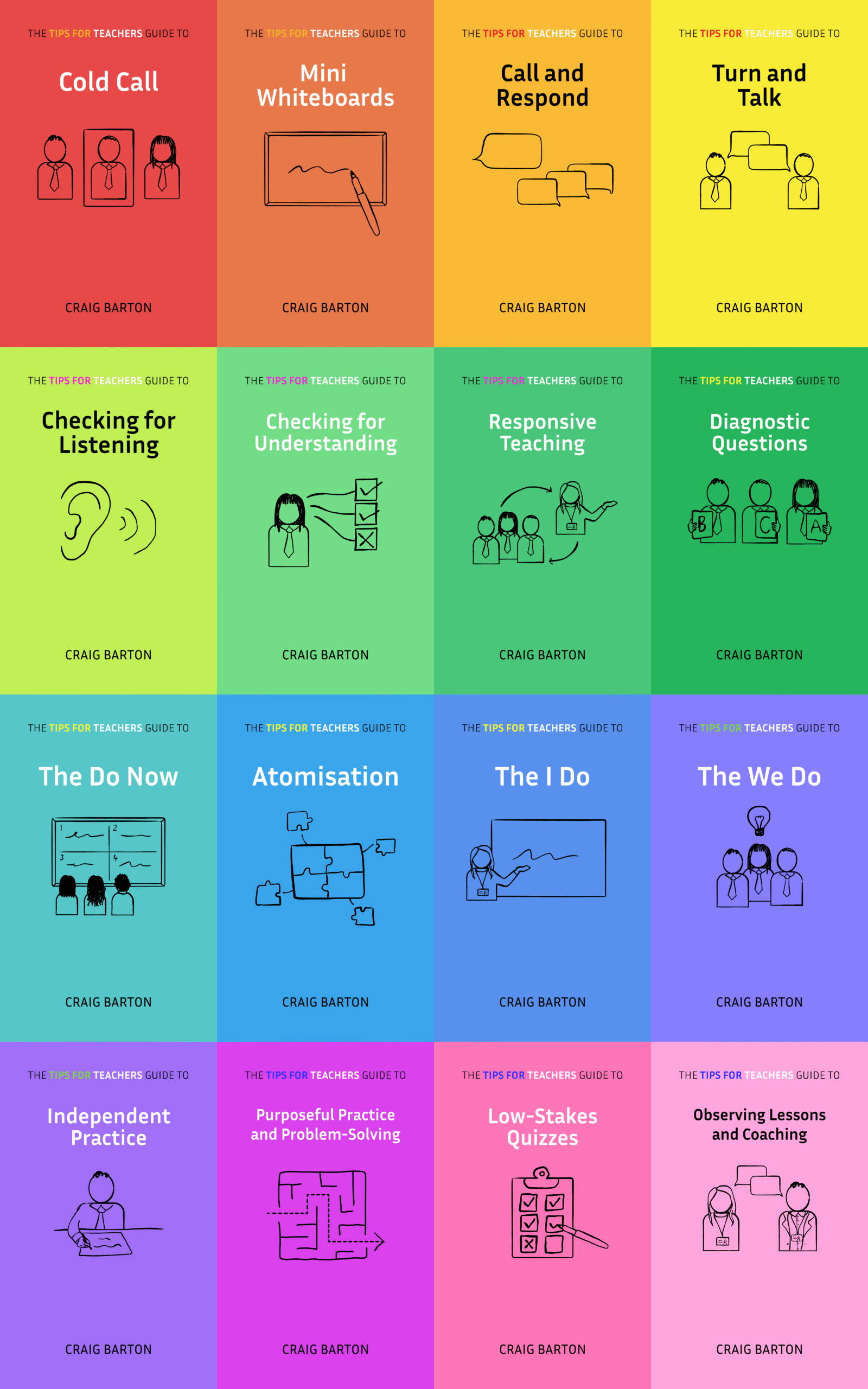
- You can read more about Atomisation in The Tips for Teachers guide to Atomisation
- You can read more about the We Do in The Tips for Teachers guide to the We Do
- You can read my post, The Myth of Copying Things Down, here
- Mayar writes about the Coherence Principle in his 2001 book, The Cognitive Theory of Multimedia Learning. There is a nice summary of the 12 principles he discusses here
- Keep it Coherent: A Meta-Analysis of the Seductive Details Effect by NarayanKripa Sundararajan & Olusola Adesope. Read an analysis of the paper here
- Investigating the impact of Accessible Pedagogies on the experiences and engagement of students with language and/or attentional difficulties by Tancredi et al. Read an analysis of the paper here
- You can access Peps’ poster and read his thoughts on accessible design here
- Five ways to increase the effectiveness of instructional video by Richard E. Mayer, Logan Fiorella & Andrew Stull. Read an analysis of the paper here
- Five ways to increase the effectiveness of instructional video by Richard E. Mayer, Logan Fiorella & Andrew Stull. Read an analysis of the paper here
- Using multimedia for e-learning by Richard Mayer. Read an analysis of the paper here
- Reducing cognitive load by mixing auditory and visual presentation modes by Mousavi Yaghoub, Low and Sweller. Read an analysis of the paper here
- Different types of redundancy and their effect on learning and cognitive load by Albers et al. Read an analysis of the paper here
- Low-Inference Verbal Behaviors Related to Teacher Clarity by Smith, Lyle R.; Land, Michael L. Read an analysis of the paper here
- The effect of clarity on learning: impacting motivation through cognitive load by Serki and Bolkan. Read an analysis of the paper here
- Low-Inference Verbal Behaviors Related to Teacher Clarity by Smith, Lyle R.; Land, Michael L. Read an analysis of the paper here
- Two meta-analyses exploring the relationship between teacher clarity and student learning by Titsworth et al. Read an analysis of the paper here
- Read more about Atomisation in The Tips for Teachers guide to Atomisation
- #170 How to secure 100% student engagement with Pritesh Raichura. Listen to our conversation here
- Read Pritesh’s post, Checks for Listening: 100% Participation, here
- I discuss this technique, and more, in The Tips for Teachers guide to Cold Call
- Wait Time: Slowing Down May Be A Way of Speeding Up by Mary Budd Rowe. Read an analysis of the paper here
- I discuss Explain, Frame, Reframe, and more, in The Tips for Teachers guide to Checking for Listening
- A meta-analysis of signaling principle in multimedia learning environments by David Alpizar, Olusola O. Adesope & Rachel M. Wong. Read an analysis of the paper here
- Self-explaining: The dual processes of generating inferences and repairing mental models by Chi, M. Read an analysis of the paper here
- ERRR #044. Alexander Renkl on self-explanation. Listen to the episode here
- Teaching Practice: A Cross-Professional Perspective by Grossman et al. Read an analysis of the paper here